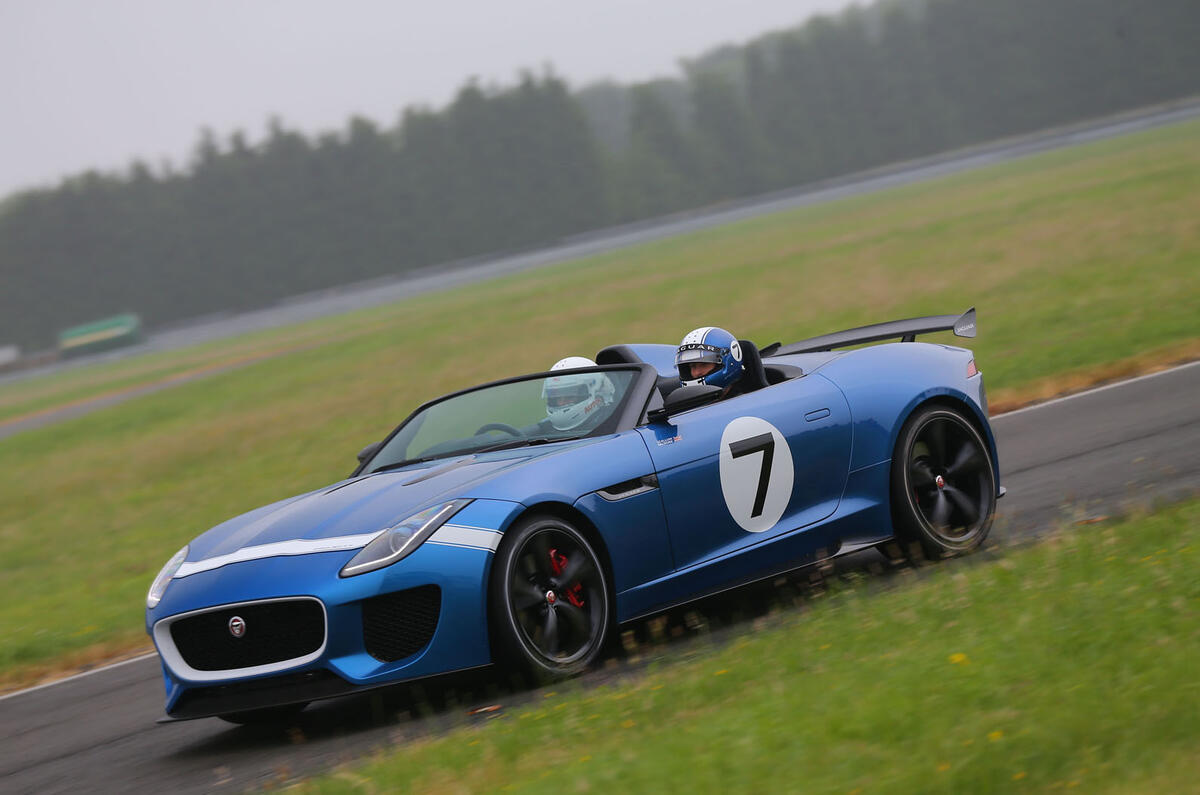





Four months. Doesn’t sound like very long to me. But just four months before July’s Goodwood Festival of Speed, where Jaguar’s Project 7 made its debut, not a single stroke of pen had been put to paper. It wasn’t so much as a thought in a designer’s head.
And the more Jaguar chief designer Alister Whelan tells me about the project, the more four months doesn’t seem very long at all.
Now, I know what you’re thinking: four months to apply some blue paint and stick a fairing on the back of an Jaguar F-Type and punt it up the hill at Goodwood? We could all do that in our spare time, couldn’t we?
I dunno. The more I hear, the more I think it’s a fairly remarkable turnaround. Cesar Pieri, a Jaguar designer whom Whelan describes as "a total petrolhead" and who has only been at the company for a year, was making some sketches in March for a modern car with a nod to Jag heritage. His colleagues liked them, and they sketched some more. A couple of days later, they slid them onto the desk of design director Ian Callum and he liked them, too. So did everyone else to whom they showed the sketches. And they decided to put it together for Goodwood.
Getting it ready
And so followed three or four weeks of further sketches and computer models, three or four weeks of real modelling at Gaydon, including milling of a full-scale clay model, which takes a week. They spent two weeks getting the fillets around the D-type-inspired rear just so, placing silver film over the clay model and working the material so that shadows, highlights and reflections are perfect.
Then there's the carbonfibre front splitter, side skirts and rear diffuser. Each of these throws up issues. Attaching the front splitter meant getting the aero team involved to decide what angle the rear wing should be, because the carbonfibre at the front upsets the front-to-rear lift balance. Likewise, the rear diffuser, while an aesthetic rather than aero touch, necessitates finishing the exhausts with a ceramic coating to stop the diffuser from burning.
The windscreen had to be cut down but, because this is a working concept, rollover strength had to be retained. And following all that, because this is a working car, the chassis engineers wanted a week on the test track at Gaydon to set up the suspension. And the graphics on those tyres? Turns out no one in the UK can do them. So the team, by hand, scrubbed off the mouldings from the sidewalls, made up the vinyl templates and did it themselves. That takes a while.
I’m adding up the time in my head as Whelan goes through it and, even accounting for the number of people wanting to work on it – in the out-of-hours kind of way that this project was completed – I’m making more than four months. Busy work.