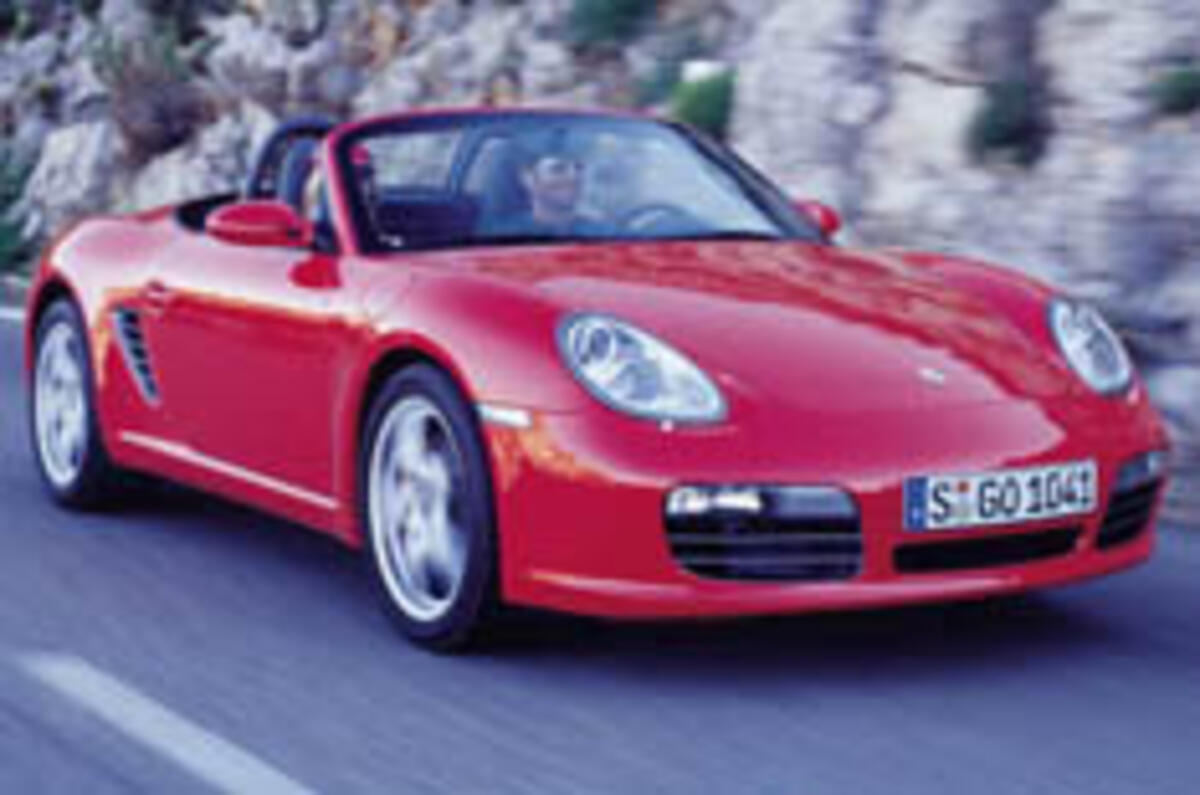

Porsche’s long-held tradition of favouring cautious evolutionary adjustments over revolutionary changes is strongly reflected in the new Boxster. Pictured here officially for the first time, Zuffenhausen’s new mid-engined rival to the Audi TT, BMW Z4 and Mercedes SLK is planned make its world debut alongside the equally new 911 at the Paris Motor Show later this month. UK deliveries are set to get underway by the end of the year. Despite its familiar appearance, Porsche claims the second-generation Boxster, codenamed 987, is effectively a brand-new car. Up to 80 per cent of its components have been either heavily revised or completely replaced, although company officials admit many of the car’s crucial hard points have been carried over from the first-generation model. Two models will be on offer from the start: a base Boxster running a 237bhp 2.7-litre version of the venerable flat-six engine, and a sportier Boxster S with a 276bhp 3.2-litre unit. You’ll need to look hard to spot the differences between old and new cars. The exterior clearly resembles that of the first-generation Boxster, launched in 1996, but every body panel has been altered.
At the front there are larger air ducts and the leading corners of the bonnet are rounded off. Oval headlamps replace the familiar teardrop-shaped units – a move Porsche hopes will silence critics who say the Boxster looks too similar to the 911. The indicators continue to be integrated in the headlamp assemblies, with separate fog lamps mounted on the bumper. The wheelarches protrude more than before, and are accentuated by more-prominent side sills underneath the reshaped doors. There are pull-out door handles, new mirror housings and the side-mounted air intakes have been redesigned for improved cooling. The tail lamps are more angular than before and wrap further around. The central exhaust has been retained: the standard car gets a single oval pipe and the S twin rounded flutes. Further changes are concentrated on the cloth hood, which has been reshaped and refined to reduce wind noise. The Boxster has hardly changed in size. At 4329mm in length, 1801mm in width and 1295mm in height, it is a mere 9mm longer, 20mm wider and 5mm higher than before. Refinements in the design of the underbody, which receives flat panelling across a larger area than before, have reduced the drag co-efficient from 0.31 to 0.29. Other changes include a modification to the rear spoiler to increase downforce. It deploys at speeds above 120km/h (75mph), extends 5mm further than before and the upper lip has been re-shaped to provide greater drag. Porsche’s aerodynamicists have also reduced lift. Both versions of Porsche’s water-cooled, four-valve-per-cylinder, flat-six engine, have received revisions to the intake manifold, combustion chambers and exhaust system for incremental increases in output and to comply with EU4 and LEV emission regulations. The 2.7-litre engine produces 237bhp at 6400rpm, up from 225bhp at 6300rpm, with torque swelling by 15lb ft to 199lb ft at 4700rpm. The Boxster S’s 3.2-litre unit has put on 20bhp and now kicks out 276bhp at 6200rpm along with an additional 7lb ft of torque, with 236lb ft arriving at 4700rpm. The revised engines are mated to an upgraded five-speed manual gearbox in the Boxster and a new Getrag engineered six-speed manual in the S. The existing five-speed Tiptronic automatic from ZF is carried over without any major changes, although it is expected to be replaced by a new dual-clutch arrangement similar to VW’s DSG within two years. With the added output comes mildly sharper performance. Porsche claims 0-62mph in 6.2sec and a top speed of 160mph for the 2.7 – an improvement of 0.2secs and 2mph. The 3.2 manages 0-62mph in 5.5sec and runs to 167mph for a gain of 0.2sec and 3mph. As with the new 911, there’s been an overhaul of the power-assisted steering. A fixed ratio of 16.9:1 has been replaced by a variable-rate arrangement that becomes progressively more direct as the steering wheel is turned. At the straight-ahead the ratio is a nominal 17.1:1, gradually altering until it reaches its most direct ratio of 13.7:1 at the bump stops. The new steering is allied to a reworked MacPherson strut suspension and tracks that have been widened by 45mm at the front and 20mm at the rear on the Boxster and by 21mm at the front and 24mm at the rear on the S. As with the new 911, the Boxster S comes with the option of Porsche Active Suspension Management (PASM). It uses adaptive dampers that vary the level of damping through two settings – normal and sport. In sport mode, the engine management also re-maps the electronic throttle to give it a more aggressive action. The suspension has been developed around new wheels and tyres that are said to provide significantly higher levels of grip. The Boxster now wears standard 17-inch wheels shod with 205/55 ZR17 rubber up front and 235/50 ZR17 at the rear. The S gets 18-inch wheels with 235/40 ZR18 front and 265/40 ZR18 rear tyres. Buyers will also be able to choose optional 19-inch wheels wrapped with 235/35 ZR19 and 265/35 ZR19 rubber. Significantly, the larger wheels allow the fitment of larger brakes. The Boxster gets 298mm front and 299mm rear ventilated and cross-drilled discs, while the S receives 318mm and 299mm respectively. The latter also gets the option of 350mm Porsche Carbon Ceramic Brakes. For Porsche engineers the real measure of any new model’s ability is how quickly it can lap the Nürburgring circuit. The new Boxster S manages a time of 8min 18sec in the hands of German rally legend Walter Rohrl. That’s 9.0sec quicker than the car it replaces and just 3.0sec shy of the 911 Carrera 2, whose 3.6-litre flat six engine produces a not-inconsiderable 45bhp more. Along with the various engine and chassis modifications, Porsche puts the improvement in lap time down to an increase in the stiffness of the Boxster’s body. Additional reinforcements within the floor pan, improved spot-welding processes and the greater use of adhesives has increased torsional rigidity by 9 per cent and bending stiffness by 12 per cent. The upshot is a slight increase in weight. The base model puts on 20kg at 1295kg, with the S up 25kg at 1345kg. Porsche has worked hard to improve the perception of quality with the Boxster and this is reflected inside, where it benefits from a new, more spacious, cabin. The general layout and materials used are closely related to those found in the new 911, but the Boxster gets its own high-quality slush-moulded fascia with unique design elements, including a quartet of round air vents. There is also a new three-spoke multi-function steering wheel that’s adjustable for rake and reach as well as a revised instrument binnacle with black-faced dials in the Boxster and white-faced dials in the S. The seats have been redesigned with a longer backrest and wider base. They are also mounted 20mm lower and have greater longitudinal adjustment than before. Safety has played a crucial role in the development of the new Boxster, which is the first roadster to incorporate a door-mounted airbag in combination with a thorax airbag to reduce injury in side impacts. Also included as standard are front airbags, the latest Bosch developed four-channel anti-lock brakes and Porsche Stability Management (PSM). By replacing the spare wheel with a repair kit, luggage space has grown by 20 litres, taking the front compartment up to 150 litres in total. This combines with a 130-litre boot at the rear to give the new car unparalleled load-lugging ability in its class. With its own factories in Germany running at full capacity right now, Porsche has once again turned to production specialist Valmet to assemble the new Boxster at its plant in Uusikaupunki, Finland. Alongside the initial roadster version, Valmet has also been commissioned to assemble a coupé version of the Boxster that’s planned for introduction in mid-2005.